

From Product Concept to Production-Ready Parts
Consumer electronics move fast. A new product can go from concept to prototype in weeks, while product updates, design changes, and market demands can happen even faster.
For consumer electronics companies, the challenge is not simply finding a manufacturer that can make parts. The real challenge is finding a manufacturing partner who can understand the design, move quickly, solve problems, and deliver consistent quality without making the development process unnecessarily complicated.
We provide custom manufacturing solutions for consumer electronics, covering CNC machining, rapid prototyping, sheet metal fabrication, injection molding, rapid tooling, die casting, 3D printing, urethane casting, and assembly.
Whether you are developing a new electronic device, testing a product concept, preparing for a product launch, or looking for a reliable source for low-volume production, we help turn your designs into real, manufacturable products.
Manufacturing Solutions for Consumer Electronics
Consumer electronics products often combine plastic housings, metal components, precision mechanical parts, brackets, heat sinks, buttons, covers, frames, and internal structural components.
Different parts require different manufacturing processes. Instead of forcing every component into one process, we select the most suitable manufacturing method according to material, geometry, tolerance, quantity, surface finish, development stage, and target cost.
CNC Machining
CNC machining is ideal for functional prototypes, precision mechanical components, metal housings, brackets, frames, heat sinks, and other parts requiring tight tolerances.
It is particularly useful during the product development stage because engineers can quickly obtain parts that are close to the final production design and test them in real assemblies.
Typical applications include:
- Aluminum housings
- Internal brackets
- Structural components
- Heat sinks
- Motor mounts
- Precision shafts and mechanical components
- Camera and sensor components
- Prototype metal parts
For consumer electronics companies, CNC machining provides a practical way to validate dimensions, assembly, functionality, and appearance before committing to production tooling.
Rapid Prototyping for Faster Product Development
A CAD model may look perfect on a screen, but that does not necessarily mean the physical product will work as expected.
Problems such as interference, poor assembly, uncomfortable ergonomics, insufficient wall thickness, difficult fastening, or unexpected deformation often become obvious only after a physical prototype is made.
Our rapid prototyping services allow engineering teams to quickly move from:
CAD → Prototype → Testing → Design Revision → Production
Depending on the application, we can use CNC machining, 3D printing, urethane casting, sheet metal fabrication, or other suitable processes to create prototypes.
This helps customers identify problems early, when they are still relatively inexpensive and easy to fix.
Injection Molding for Consumer Electronics
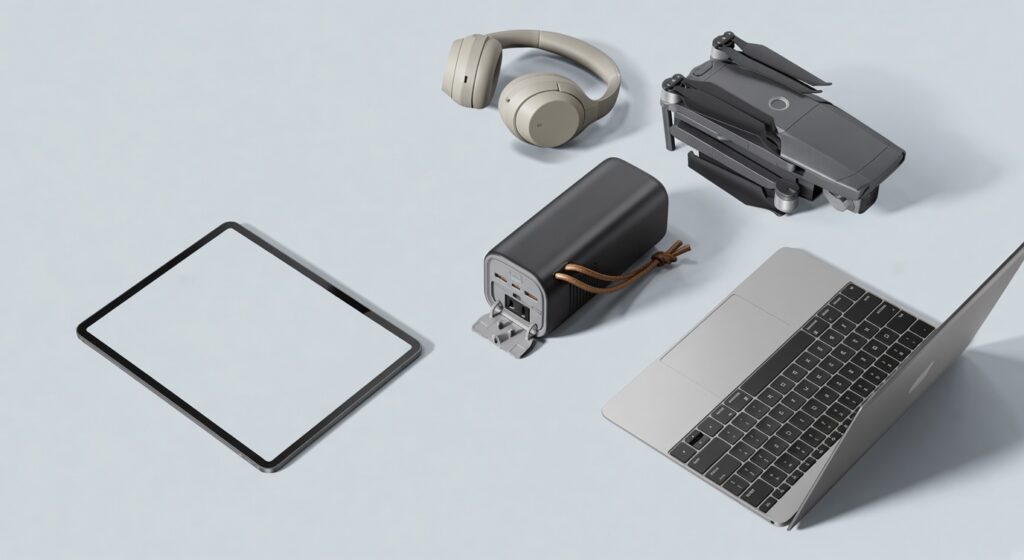
Plastic is everywhere in consumer electronics.
From wireless chargers and smart home devices to handheld electronics, controllers, sensors, and electronic housings, injection molding is one of the most important manufacturing processes for producing high-volume plastic parts.
We support customers from prototype tooling and rapid tooling through production injection molding.
Typical applications include:
- Electronic device housings
- Battery covers
- Remote-control housings
- Smart home device enclosures
- Plastic brackets
- Buttons and switches
- Internal structural components
- Connectors and covers
The goal is not simply to make a mold. A good injection molding solution should consider the product from the beginning, including part design, draft angles, wall thickness, ribs, bosses, gate location, ejection, warpage, shrinkage, and assembly requirements.
By considering manufacturability early, we can help reduce unnecessary tooling modifications and shorten the path from prototype to mass production.
Rapid Tooling for Shorter Time to Market
Traditional tooling can require significant time and investment, which may not always make sense for a new product, market test, or low-volume launch.
Rapid tooling provides a practical alternative when customers need production-like molded parts but want to reduce development time and initial tooling investment.
It can be especially useful for:
- Product validation
- Engineering verification
- Market testing
- Pilot production
- Low-volume production
- Pre-production builds
Instead of waiting until every detail is perfect before making physical parts, companies can use rapid tooling to obtain real molded components, test them, collect feedback, and make informed decisions before scaling up.
Sheet Metal Fabrication for Electronic Products
Not every component needs to be injection molded or CNC machined.
Sheet metal is often a cost-effective solution for brackets, frames, covers, chassis, mounting plates, shielding components, and internal structures.
Our sheet metal manufacturing capabilities can support processes such as:
- Laser cutting
- CNC bending
- Punching
- Welding
- Riveting
- Threading
- Surface finishing
- Assembly
For consumer electronics products, sheet metal components can provide a combination of strength, durability, structural stability, and cost efficiency.
They are particularly useful for products that require a rigid internal frame or metal enclosure without the cost and lead time associated with more complicated manufacturing processes.
Low-Volume Manufacturing Without the Headache
One common problem for consumer electronics companies is the gap between prototyping and mass production.
You may only need 50, 200, or 1,000 units for a product launch, customer trial, Kickstarter campaign, engineering validation, or market test.
But traditional mass-production suppliers may not be interested in such quantities, while prototype suppliers may not be set up for repeatable production.
This is where low-volume manufacturing becomes valuable.
We help bridge the gap between prototype and mass production by providing scalable manufacturing solutions based on the actual production requirements.
This allows customers to:
Build → Test → Launch → Improve → Scale
without making a large production commitment too early.
One Manufacturing Partner for Multiple Processes
A consumer electronics product rarely consists of one type of component.
A typical product may require:
CNC machined aluminum parts + injection molded plastic housings + sheet metal brackets + 3D printed prototypes + fasteners + surface finishing + final assembly
Working with multiple suppliers for these components can create unnecessary communication and coordination problems.
Different suppliers may have different quality standards, lead times, documentation requirements, and communication styles.
By combining multiple manufacturing processes under one supply chain, we help customers simplify supplier management.
Instead of spending time coordinating several manufacturers, your engineering or procurement team can work with one manufacturing partner for multiple types of custom parts.
This can make the development process easier to manage and reduce the risk of delays caused by poor coordination between suppliers.
Solving the Problems Engineers Actually Face
We understand that manufacturing problems are rarely as simple as “Can you make this part?”
Engineers and product developers often have to deal with questions such as:
- Can this part actually be manufactured as designed?
- Is the tolerance realistic for the selected process?
- Will the plastic part warp after molding?
- Is the wall thickness sufficient?
- Where should the injection gate be located?
- Can this component be machined economically?
- Should this part be CNC machined or injection molded?
- Is the design ready for tooling?
- Can we reduce the part cost without compromising functionality?
- How can we make the prototype faster?
- Can the supplier support both prototypes and low-volume production?
- Will the parts fit together during assembly?
- Can the same supplier handle multiple components?
These are engineering and manufacturing questions, not simply purchasing questions.
Our approach is to look at the entire manufacturing process, rather than treating each drawing as an isolated part.
Design for Manufacturing Support
A good manufacturing partner should not simply wait for a drawing and then send back a quotation.
When appropriate, we review designs from a manufacturing perspective and identify potential issues before production.
This may include:
Tolerance → Material → Wall Thickness → Draft → Machining → Tooling → Surface Finish → Assembly → Cost
Early feedback can help prevent expensive problems later.
For example, changing a small feature during the prototype stage may take minutes. Changing the same feature after an injection mold has been completed can require significant additional time and cost.
That is why design for manufacturing (DFM) is an important part of our approach to consumer electronics manufacturing.
Quality That Works in the Real World
Consumer electronics often have demanding appearance and functional requirements.
A part may need to look good, fit precisely, survive repeated assembly, and perform reliably in the finished product.
Depending on the project, quality requirements may include:
- Dimensional inspection
- Critical tolerance verification
- Material verification
- Surface finish inspection
- Cosmetic inspection
- Assembly testing
- Functional testing
- First Article Inspection
- Production inspection
The specific inspection plan should be based on the actual product requirements rather than applying unnecessary inspection procedures to every component.
Our goal is simple:
Make the parts according to the drawing, understand what is critical, and make sure the finished components work in the final product.
From Prototype to Production
One of the biggest advantages of working with an experienced manufacturing partner is continuity.
A supplier that only makes prototypes may not understand the requirements of production.
A supplier that only focuses on mass production may not be flexible enough during early-stage product development.
Consumer electronics companies often need both.
Our manufacturing capabilities support different stages of the product lifecycle:
Concept Development
↓
Rapid Prototyping
↓
Engineering Validation
↓
Design Optimization
↓
Rapid Tooling
↓
Low-Volume Production
↓
Mass Production
This means customers can use different manufacturing processes at different stages without completely rebuilding their supply chain every time the product moves to the next phase.
Why Consumer Electronics Companies Work With Us
Faster Development
Shorten the time between CAD files and physical parts, allowing engineering teams to test and iterate faster.
Flexible Manufacturing
Choose from CNC machining, injection molding, sheet metal fabrication, 3D printing, urethane casting, die casting, and other processes according to project requirements.
Engineering-Oriented Communication
We understand drawings, tolerances, materials, manufacturing processes, tooling, and assembly requirements—not just purchase orders.
Prototype to Low-Volume Production
Support projects beyond the prototype stage, including pilot builds and low-volume manufacturing.
Multiple Processes Under One Supply Chain
Reduce the complexity of managing several suppliers for different components and processes.
Cost-Conscious Solutions
Instead of simply choosing the most expensive manufacturing process, we consider quantity, application, tolerance, material, tooling investment, and production requirements to find a practical solution.
Practical Problem Solving
When something cannot be manufactured exactly as designed, the goal is not simply to say “no.” We look at what is actually causing the problem and work toward a manufacturable solution.
Built for the Speed of Consumer Electronics
The consumer electronics market does not stand still.
New products appear every year. Existing products receive constant upgrades. Components become smaller, designs become more complicated, and companies need to respond to market feedback quickly.
That makes manufacturing flexibility increasingly important.
Whether you need one functional prototype, 100 pilot units, or a complete manufacturing solution for a new electronic product, we can help you move from engineering design to physical production with fewer unnecessary steps.
If you have a 3D CAD model, 2D drawing, BOM, prototype requirement, or simply an idea that needs to be manufactured, send us your requirements.
We will review the project, recommend suitable manufacturing processes, identify potential manufacturing issues, and provide a practical solution based on your product and production goals.
From prototype to production, we help turn consumer electronics designs into real products.

 wade@axiprecision.com
 +8613686195573